X
Categories
essay

Leveling Up the Skill of Friendship: The Why

Says the popular adage:

Give a man a fish and you feed him for a day.

Teach a man to fish and you feed him for a lifetime.

Teach a man to make friends and now all his fisherman buddies give him freshly caught fish whenever he visits them down by the pier, plus they water his plants when he’s out of town, plus they help him pull through when he’s feeling down, plus he’s also friends with the bakers so he gets fresh BREAD in addition to the fish.

At the risk of stating the blindingly obvious, friends are great. Almost any relationship, including romantic or professional ones, is better when it involves friendship.

But friendship isn’t necessarily easy or natural. Everyone is somewhere between good and bad at it.

Friendship is, in fact, a skill. Even if we rarely think of it as one.

And unless you’re especially talented, or unless you’ve deliberately practiced, there’s a reasonable chance that you’re not as good at friendship as you could. Yet there may not be a skill worth mastering more, as the (totally authentic) proverb above illustrates.

This is an introductory essay in what I expect to be a series of posts on friendship. Here, we’ll discuss the “why”: why friendship is a skill, and why it’s an important one. At the end, we’ll briefly lay some groundwork for another essay about the “how.”

But first, a personal anecdote.

An auction of dreams

In the Quebec secondary school system, there used to be a class called “Personal and Social Development.” It was a hodgepodge of sex education, ethics, and other things neither I or my high school friends can remember.1though many of us remember that time the teacher brought a chocolate cake made with mayonnaise, which seemed like a mind blowing idea at the time.

One of the few things I do remember from that class was the “auction of dreams” we had once. The teacher would read out some ambitious life goals, like “to become the prime minister,” and we would bid points to buy them. The one dream I won was “to have a true friend.” I didn’t need to spend a great deal of points for it; my classmates seemed less interested. Perhaps because, to them, it felt more ordinary than the other dreams, or more easily attainable.

But I knew that making new friends was, for me, a slow process. That deep, true friendship was rare. I wasn’t (and am not) disastrously bad at social skills, but I’ve always felt a bit below average, just enough to often be somewhat dissatisfied with my social life. I regularly wish I were part of some cohesive community of friends.

In the narrative of my life, that auction of dreams has become a defining moment. A sign I knew I was slightly inadequate at something very important.

Usually, though, I’m doing just fine. “Usually” as in “when there isn’t a horrible virus floating around and forcing us to cancel so many of the good things in the world.” The pandemic contact restrictions feel as if someone had detonated dynamite in the fragile social life that I had been slowly and painstakingly growing for years. It’s not that I’ve lost friends. But all the contexts — work, organized activities, parties — in which we effortlessly and serendipitously spend time with people are now gone. Social interaction has become more intentional. It takes more energy.

So I’ve been sitting at home, wondering how to save what I could, and how to efficiently rebuild my social life. Then I happened upon the work of Visakan Veerasamy, better known as Visa. If your Twitter is anything like mine, you’ll know who I’m talking about. He’s all over the place.

Visa’s mission is “to build the greatest social graph of friendly, ambitious nerds that the world has ever seen.” As he writes in his book Friendly Ambitious Nerd:

Friendliness​ is about being a nourishing presence. It’s about becoming somebody who people (including yourself!) love and enjoy. It’s about creating supportive, encouraging spaces where people can feel comfortable sharing their honest feelings. Humans are a social species, we’re practically wired to desire kinship, to be part of something bigger than ourselves. So why not get good at it?

Yeah, why not? Why not see it as a skill, as something you can learn and master?

You can be good or bad at basic human needs

I can think of a few reasons why friendship is rarely framed as a skill.2It’s more common to talk about “social skills,” but my view is that this is both more general and less important than just friendship. One is that almost everyone picks it up to some extent in their youth, usually in school. Another is that socialization is a basic human need. So we learn the art of friendship the same way we learn the art of eating: as a necessity for survival.

But even a basic need like eating involves several activities that we can be good or bad at: selecting foods to buy, meal planning, cooking, picking a restaurant, finding a balanced diet, and even just enjoying what you eat.3Some people apparently never enjoy their food, and eat for sustenance only. For an example, read the beginning of this Slate Star Codex piece.

Similarly, the skill of friendship comprises a bunch of things we can be good or bad at:

  • making new friends
  • keeping in touch; general friendship maintenance
  • providing support and value to friends
  • moving from a superficial to a deeper friendship
  • managing conflicts and unhealthy dynamics
  • ending a friendship, as we sometimes must.

Even though most people learn to do most of these things from a young age, there are signs that we’re not, collectively, that good at them. Many people are lonely, and the media regularly mentions a “loneliness epidemic” (it’s unclear that there really is such a thing, depending on whether you focus on subjective perception of loneliness or increased atomization, but the fact that we worry about it is telling). It’s not uncommon to hear friends say they “haven’t been a good friend” when you talk to them for the first time in a while. And it has become trite to state that “it’s hard to make friends as an adult.”

Of course, there are many reasons why it can be hard to make friends, or why we feel socially isolated. Lack of skill perhaps shouldn’t be seen as a cause. But surely becoming skilled at the items in the list above can be an antidote.

Now, is it worth our time, relative to other skills we could learn?

Friendship as magic

What are friends good for?

I don’t think I really need to enumerate this. But let’s do it anyway.

There is the mundane: having your fish fed when you travel, borrowing stuff you need. There’s everything related to mental wellbeing: staving off loneliness, feeling important, getting emotional support when things fall apart. And then there’s what we like to call “networking”: finding jobs, ideas, projects, things to learn, people to meet, and more friends.

Friends are also shortcuts to skills you don’t have — like fishing. It’s more common to get these shortcuts through commercial transactions, of course, by trading some skill you have for money and then trading the money for someone’s services. But friendship provides a second way to “cheat.” It can even be the skill that earns you a living, if you’re especially good at it — through sales or community organization, for instance.

One cool way of describing the benefits of friendship is in terms of luck. Luck is a word we use to describe the good things that unexpectedly happen to us. Unlike what you may think, it’s  perfectly possible to increase your luck. You simply have to expose yourself to as many situations with potential good outcomes — new opportunities — as you can.4I was reading Antifragile by Nassim Taleb as I was writing this piece, and it sounds like Taleb would call this “optionality” as opposed to luck. You increase the probability of a good outcome by giving yourself more options, especially those with more potential upsides than downsides. I’m okay with calling this luck.

And what better way to do that than interact with lots of people who like you?

So friends can provide you with material benefits. They can replace the need to learn some skills. They allow you to manipulate luck. And they do all that while making you feel great.

Life skills don’t get any more magical than that.

logo of My Little Pony: Friendship is Magic

right, I knew I’d seen this idea expressed somewhere before

Towards the how

Okay, so how do we master the skill? How do we get better at making new friends, managing friendships, being a good friend, and dealing with the unfortunate uglier parts?

This question deserves a full essay, and one that I’m planning to write very soon. (Feel free to subscribe if you don’t want to miss it.)

The central point, however, is clear. To be good at friendship, you need to be a valuable person to your friends. You can be valuable in many ways, but most boil down to two main qualities: be kind, and be interesting.

To be kind is to care about the people around you. To remember their names and birthdays. To be there when they need help. To apologize when you’ve wronged them. To have empathy.

To be interesting is to bring value to your friends. To teach them things. To bring them new encounters and opportunities. To be a good conversation partner. To nourish their minds.

How can we get better at being kind and interesting? How do we level up the skill of friendship? There are many paths. But the first step is to realize that it is a skill.


Many thanks to the amazing people who read drafts and provided feedback: Gregory Yang Kam Wing, Sarah Boudreault, Rhishi Pethe, Carolina Perez, Padmini Pyapali, Alexander Hugh Sam, Charlene Wang, Sachin Maini, Nivi Jayasekar, Snigdha Roy, Mohammed Malik, Tom White, Alicia Kenworthy, Kritika Sony, and Christian Keil.

Categories
misc

The Name of the Blog

Why is this blog called “Dark Gray Matters”?

The true answer is mundane: I was trying to come up with a name and I liked the sound of this one.

But sometimes ideas — if they’re good — reveal surprising depth. I realized that this name can be decomposed in six different ways: three individual words, and three two-word combinations. Each of these subnames has meaning of its own, and thinking about them helps me define what the blog is about.

Here’s an overview.

Dark

This word is the toughest to extract meaning from, since it carries connotations of evil. But not all that is dark is evil. The night is dark, and yet the night can be soothing, or beautiful, or exciting.

Often, it is when we look at the darker corners that we find what is most interesting. And darkness allows light to shine more brightly. It makes contrasts, and emphasizes what is good: art, for instance, is a beacon in the darkness.

This blog is about the darker, more interesting bits of the world.

Gray

If the world were monochrome,1The world isn’t actually monochrome, so I get to pick another official color for the blog than gray. That color is purple, because purple’s great. almost nothing would be pure white or pure black. Everything would be some shade of gray.

In probability, there are never absolute certainties: everything is gray. In politics, no one is always absolutely right: everything is gray. In science, we seek truth, but we never find it fully: everything is gray. In relationships, we always find people to be simultaneously flawed and marvelous: everybody is gray.

This blog is about the grayness of things.

Matters

The noun “matter” has many meanings. The verb “to matter” has only one, but it is a striking one. “To matter” is to be important. What could possibly be more important than discovering, and acting upon, what is important?

This blog is about finding what matters.

Dark Gray

Now we’re looking at word combinations, and this allows us to get more precise.

I said the world is not black and white. But neither is it a perfectly neutral, balanced gray.

Paul Graham distinguishes “intentional moderates” from “accidental moderates.” Intentional moderates strive to be in the center, and purposely choose their opinions to be away from the extremes. Accidental moderates end up in the center because they think for themselves — and since both black and white are equally wrong, they become gray.

You recognize an accidental moderate from the diversity of their opinions. Rarely will they be neutral gray on any given question. They almost always give the dark gray or the light gray2In the abstract, light gray and dark gray are the same. answer. Only on average are they neutral gray.

This blog is about picking sides.

Dark Matters

We don’t really know what dark matter is. That’s why we called it that. But whatever it is, there’s a lot of it. 85% of all matter is dark matter.

This is an obvious metaphor for the fact that we know very little about the Universe. Almost everything is still unknown, waiting to be discovered. Some of that is the infinite smallness of fundamental physics, and some is the infinite largeness of the cosmos. Some is about how our planet works. Some is about how we, the humans, work.

This blog is about curiosity, pointed at the entire Universe.

Gray Matters

And the most awe-inspiring part is that there are things in this Universe that are able to look and wonder at the rest.

That’s us. The humans, and to varying degrees, other animals. We have nervous systems, which include a brain, which includes a mass of billions of neuronal cell bodies, enmeshed together. We call that part gray matter. It is able to do something really bizarre: it thinks.

Nothing would matter if there were no thinking beings to experience it. Everything comes together because we’re able to think. And the world can be a better or worse place depending on how well we think.

This blog is about us.


Thanks to Gregory for help with the first draft.

Categories
essay

Things You Shouldn’t Abstract Away

We use words to abstract things. When you say the word “tree,” you summon the abstract idea of a specific concrete thing that looks like this:

No real tree is being moved, harmed or otherwise affected when you use the word. This allows you to do whatever you want. With words, you can cut down trees, paint them pink, make them represent the entire history of life, make a political promise to plant two billion of them, or even pretend the entire world is a tree, and at no point are actual trees being involved.

That’s how powerful abstraction is. In fact, the use of language to manipulate imaginary objects is probably a defining feature of humanness and a big part of why we’re so successful as a species.

But sometimes, that power feels greater than it truly is.

“I don’t want [X] to matter”

Take charisma. It is an abstract word that refers to a real phenomenon, but that phenomenon is remarkably difficult to describe. A charismatic person is one who is persuasive, charming, attractive, fascinating, good at speaking, good at leading, or any number of similar ideas in that space. Fortunately, you generally don’t need to do the heavy work of defining what you mean: you can just use the convenient word “charisma” to encapsulate part or all of that.

Since you have this word, you may be tempted to say something like: “I don’t want to choose politicians according to their charisma. I want only their ideas to matter.”

Reasonable, right?

The thing is, it’s really hard to actually ignore charisma. Suppose you heard ideas from two candidates during a debate. One is articulate, pleasant to listen to, and crystal clear. The other is boring, monotonous, and vague. Regardless of the quality of their ideas, chances are you’ll be convinced by the former. You may not even realize it’s because of their charisma.

It’s not impossible to discount charisma. You’d need to make a conscious effort and say, “I know this guy is much better at expressing his ideas, but that doesn’t mean his ideas are the best.” And you need to do that for his seductive voice. And his joke telling. And whatever other qualities get lumped into the word “charisma.”

Hiding away all of these things, and using the word “charisma” as if it were something you had control over, actually puts you at greater risk of falling for charisma. In fact, it puts you at the same risk level as someone who’d have no awareness of charisma at all.

Marketing works in a similar way. You want to buy the best product, not the one that is best marketed. But how do you know which product is the best? You need to acquire the information somehow. And unless you’re an insider, the information you’ll get is likely to be heavily influenced by various forces — the product’s name and design, or the number of times you’ve heard of it, which is directly related to the money spent on advertising — that we often call, together, “marketing.”

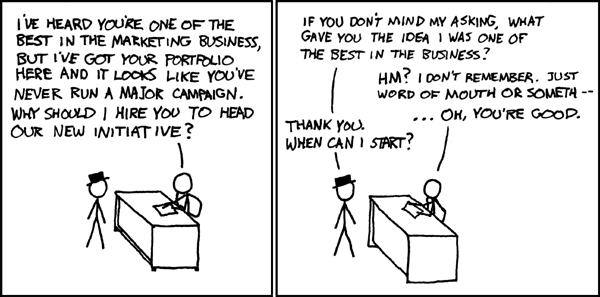
To complicate matters a bit, marketers know that people don’t like “marketing” (especially ads), so the successful ones go out of their way to make their marketing not feel like marketing. You didn’t pick the restaurant that had paid ads on Facebook — you just went with the one your friend recommended. It never occurred to you that this recommendation might have been the result of clever marketing.

(as usual, there’s a relevant xkcd)

So, just like true charisma includes the capacity to win over people who are wary of abstract “charisma,” true marketing is able to reach even people who actively dislike abstract “marketing.”

My third example is networking. People think of networking as this thing you do. You go to “networking” events. You “network” by adding people on LinkedIn. You complain that you can’t get a good job because only the people with a better “network” get them, regardless of their competence.

It’s easy to realize that networking just means meeting people, but somehow we rarely think of it as “networking” when you make a new friend and eventually get help from that friend. Even when you get a very clear advantage from your network — say, you have a family member who’s good at manual work and gets some improvement done on your house — you won’t think of it as a result of your networking. I mean, that’s what family and friends are for, right?

And if you wanted to get rid of networking as a hiring criterion — well, you’d be attempting to tame something that’s too strong. The better-networked people are more likely to have heard of the job, or to know somebody at the company who can refer them. You can’t do much against that (and probably shouldn’t try).

Abstracting power away

The phrasal verb to abstract away is used mostly in computer science. It means to hide the complexity of a task behind some sort of black box, in order to simplify. You don’t care how exactly a computer program sorts the items in a list; you’re happy to just click some command called “Sort alphabetically” and trust that your Excel data is now in alphabetical order.

More generally, I propose to use this verb for situations where using a word — i.e., abstracting a thing — hides most of the power of the thing.

Abstracting away is a step beyond plain abstracting. (Plain abstracting boils down to using language, so this isn’t surprising.) When you refer to a concrete object like a tree, nothing powerful gets hidden. Trees don’t have any power over you1At least, I hope they don’t..

If the power of a thing is obvious, you’re also not usually abstracting it away. It’s quite clear to everyone that “gravity” or “the government” refer to important forces that influence people, so there’s little risk of thinking you have a better hold on them than you really do.

Charisma, marketing, and networking are in the dangerous middle: they’re powerful concepts, but not obviously so. That’s why it’s easy to abstract them away, and get confused about the world.

So, be careful. Abstract language has given you great power. But there are other things out there that are powerful. Don’t think you can defeat them that easily.


Thanks to Annie Bastien and Gregory Yang Kam Wing for reading a first draft and providing discussion.